What the demo is really teaching
Several playthroughs of the same free slice agree on the mechanics and disagree on almost nothing else. What follows is what the demo teaches, why it teaches it that way, and where the lessons stop being trustworthy.
The bar is not a dodge budget
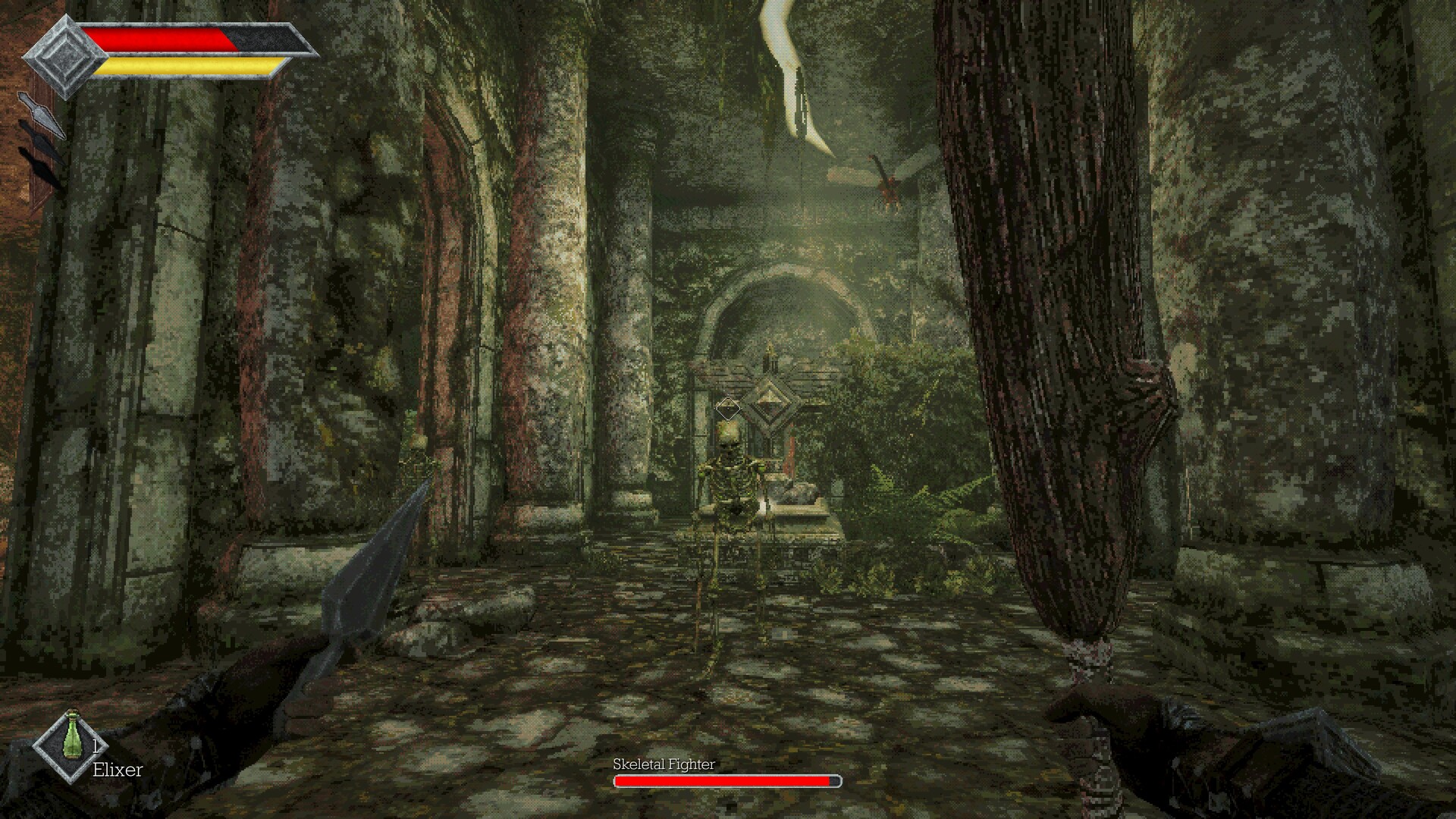
Every action RPG in this lineage uses stamina to stop you rolling forever. Queen’s Domain uses it to stop you swinging. One sword swing takes the bar to zero, and the next swing, taken while it refills, lands weaker than the first. Keep mashing and you keep producing weak hits while leaving yourself no resource to disengage with.
Playthroughs of the demo converge on that consequence from opposite directions. One player counts the swings out loud and concludes that a single hit is the entire affordable budget per engagement. Another arrives at it through frustration, discovering that the rusted sword’s reach and damage do not justify what it costs. A third stops attacking and starts asking whether a fight can be opened without spending the bar at all.
That last question is the one the design wants asked, and it has an answer: throwing weapons. Daggers are not consumed, so they are not a limited resource saved for emergencies. They are a second attack that costs no stamina, which makes them structurally different from every throwing item in the games this one descends from.
Reach beats damage, on purpose
Once a swing is your whole budget, the swing that lands from outside the reply is worth more than the swing with the bigger number. This is why the spear outperforms the sword in the demo even though the sword is the legendary weapon of the story, and why the club’s slow overhead swing is a specialist tool rather than an upgrade.
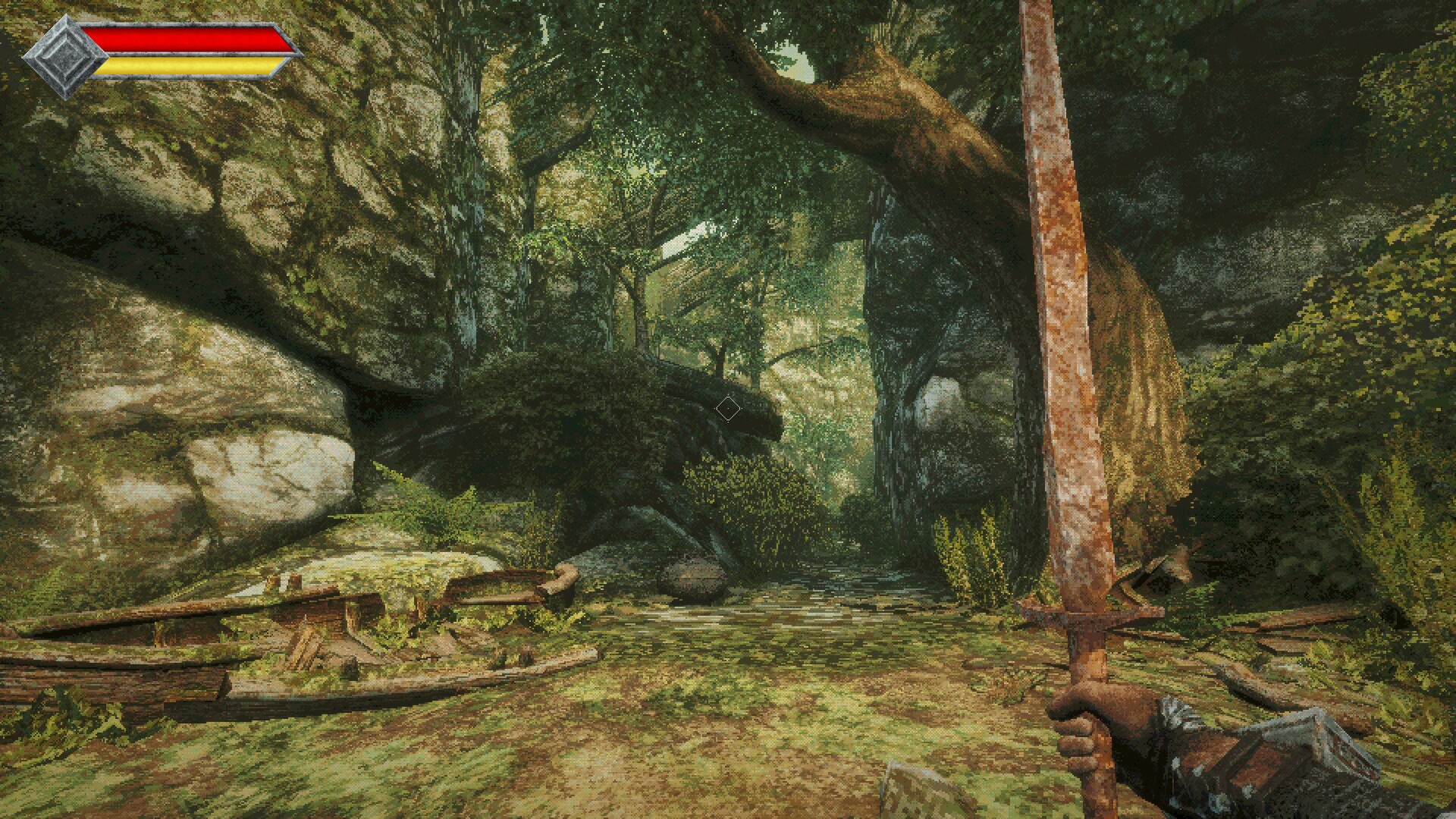
The demo supports that conclusion mechanically rather than narratively. Weapon stats are visible, the starting sword’s numbers are unremarkable, and its range is short. The spear that turns up shortly afterwards is not presented as a prize, yet players who pick it up stop dying to the same enemies. A blunt reading is that the starting weapon is badly balanced. A fairer reading is that the starting weapon is a lesson about reach, delivered before the game lets you choose anything better.
Three types, and enemies that refuse the wrong one
Slashing, piercing and impact are not cosmetic labels. The demo teaches the distinction with geometry: ratty bugs, small and close to the ground, die to a slash; skeletal warriors ring off a blade and fold to a club; armoured enemies make a sword look like a stick. Players working through the same corridor independently reach the same conclusion, and one states the negative case plainly after the sword fails to bite at all.
What makes this more than a colour chart is that the three weapon types are not equally easy to use. Impact arrives with a wind-up long enough that swinging a club at a fast enemy is its own mistake. The correct answer to an armoured opponent is therefore not simply to bring impact; it is to bring impact and pick the moment — the stamina lesson taught a second time through another system.
Proficiency is quietly the real progression
Character levels exist, and the official material confirms that experience raises your stats and that food raises them further. What the demo makes you feel, though, is weapon level: individual weapons gain levels through use, and the bonus shows up as attack power and speed on that specific weapon. One player notices a weapon level-up before a character level-up and has to check which one happened; another remarks that weapons levelling with use is a system they wanted in more games.
The effect on how you play is larger than it sounds. If proficiency is per weapon, swapping to the right damage type costs more than the moment the swap takes: you are finishing the fight with a weapon that is behind. The full game promises more than fifty melee weapons, which turns that tension into the central build question. In the demo it is already visible, just small.
Saving and resting are different verbs
Save points are crystal statues and there is no autosave. Resting at one restores health, cures status effects and respawns every enemy in the area. Saving alone writes progress and leaves the room as you left it. Players work this out with visible suspicion — one explicitly tests whether a plain save revives enemies, and confirms that it does not.
That is a small rule with an outsized effect on how the crypt plays. In most games of this shape, a safe return to a save point forces a re-clear on the way back, which turns caution into tedium. Here the two functions are separated, so a careful player can bank progress without undoing the work that earned it, and pays the respawn cost only when the heal is actually needed. Death handling continues the theme: dropped loot is retrievable rather than lost, so a bad pull costs a detour instead of a run.
The doors are the design
The demo’s most consistent feature across every playthrough is a refusal. The mausoleum is barred. You find a key; it does not fit. It opens the Endu shrine gate instead, a door with the name of your own sword on it. Meanwhile the traversal ability the store page advertises — flight with Endu, upgraded to fly further — is present but unupgraded, so the gaps you can see stay just out of range.
Players respond in two ways, and both are informative. Some hunt for a double jump or a wind jump, reasoning that a ledge that visible must be reachable. Others accept the leash and start mapping what they can already reach. The demo is built to produce both reactions, because a slice that ends at a locked gate is a promise, and a promise is only interesting when the gate is visible from where you stand.
Where the evidence stops
None of this is numeric. The demo does not display stamina costs, regeneration rates, damage values or drop rates, and the developer has not published them. Every claim above concerns behaviour you can watch: the bar empties, the second swing is weaker, the club staggers a skeleton, the crystal respawns a room. Where the sources fall silent — the exact weakness of the armoured knight, the phase structure of the Necromancer, whether food is a buff or a heal in the full game — this guide says so rather than filling the gap.
That restraint is the point. A guide that invents a stamina percentage is useful for one afternoon and worthless afterwards; a guide that says the bar empties on one swing, and shows the footage, stays true after launch, when the numbers finally become public and can be added properly.